

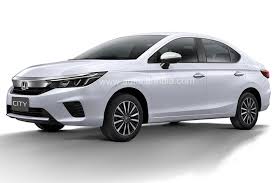
The Honda City 2026 arrives as a refined, practical midsize sedan that leans harder into fuel efficiency, safety tech, and comfort than ever before and it’s available in multiple powertrains and trim levels depending on market. What this really means is buyers get a choice between the familiar 1.5-liter i-VTEC petrol, updated CVT or e-CVT automatics, and market-specific mild-hybrid or e:HEV hybrid options, with trim packages tuned for tech, driver-assistance, and interior comfort.
Why this review matters:
If you’re deciding between compact sedans for daily commuting, occasional long drives, and a family-friendly cabin, the Honda City 2026 is built to be efficient, low-stress to own, and competitive on features-to-price. The rest of this article breaks down styling changes, full specs, engine and fuel economy numbers, safety systems, infotainment and connected features, regional pricing examples, and buying advice all written so you can decide fast and confidently.
Honda City 2026 headline summary:
Honda kept what works and tuned everything else: better interior ergonomics, a sleeker face, more driver assistance features as standard on higher trims, and the same dependable reputation for longevity and low ownership cost. Markets will differ on exact engines and pricing, so I include regional notes and official references where available.
Exterior design and first impressions:
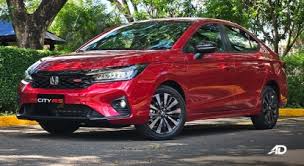
The 2026 City shows evolution, not revolution. Expect a sharper front grille, slimmer LED headlamps, refined bumpers and new alloy designs that make the car read a touch more upscale than the previous model. Small changes to lamp signatures and wheel designs lift perceived quality without changing the City’s compact dimensions, which keeps parking and urban maneuvering effortless. Reports prior to the 2026 updates flagged a facelift focused on the grille, bumpers and lamp design that’s exactly what surfaced in early show reveals.
Design details worth noting:
- Front fascia: slimmer LED DRLs, revised grille geometry for a cleaner face.
- Profile: new alloy wheel patterns and slightly revised roofline cues to emphasize rear passenger space.
- Rear: reworked tail-lamp graphics and a tidier bumper with integrated reflectors.
What this means on the road: improved wind noise and a slightly quieter cabin in highway cruising due to better seals and minor aero tweaks.
Interior, comfort and materials:
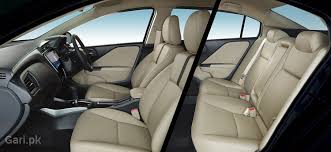
Honda’s priority here is space and usability. The 2026 City keeps one of the segment’s most generous rear legroom figures while upgrading materials on dash surfaces and seat upholstery in higher trims. The center stack favors a larger touchscreen in upper trims and a simpler, physical control layout for HVAC on base models — a practical compromise that reduces distraction.
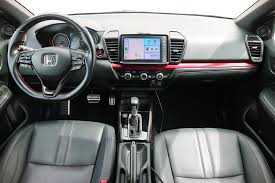
Cabin highlights:
- Passenger space: class-leading rear legroom and a flat floor feel for two adults in back.
- Ergonomics: driver-focused dash with reachable controls and clear visibility.
- Storage: deep door bins, a large glovebox, and class-competitive boot volume.
Infotainment and connectivity:
Higher trims get a larger touchscreen with wireless Apple CarPlay and Android Auto, Bluetooth streaming, and optional embedded connectivity packages (regional-dependent). Wireless phone charging and multiple USB ports are available on mid and top trims. These features make the City feel modern without overcomplicating the operation.
Powertrains and performance (engine specs):
Honda’s 1.5-liter i-VTEC remains the backbone for most markets, tuned differently by region. Expect an output range around 115–121 hp with torque figures that favor low-to-mid range drivability. Transmission options typically include a smooth CVT and, in some markets, a 6-speed manual for enthusiasts. Hybrid e:HEV or mild-hybrid systems arrive in select regions aiming to boost urban fuel economy and lower emissions. Official regional spec pages list the 1.5 i-VTEC as a core option.
H3: Real-world fuel economy
Depending on powertrain and driving conditions, expect combined economy in the ballpark of:
- Petrol CVT: roughly 16–18 km/l (real world varies by region).
- Hybrid variants: clearly improved urban figures, often netting best-in-class city consumption where available. Real-world reports place efficiency near 17–18 km/l in mixed driving for the newer powertrains in some markets.
H3: Driving feel
The City 2026 prioritizes comfort over sporty dynamics. Steering is light and predictable, suspension is tuned toward isolation, and the CVT provides smooth response for city driving. If you want a sportier feel, search for sport mode trim options or look at sport-tuned editions where Honda offers slightly firmer damping.
Safety and driver assistance:
Honda’s safety suite continues to expand. For 2026 the City includes Honda Sensing or regional equivalents in higher trims: adaptive cruise control, lane-keep assist, automatic emergency braking with pedestrian detection, and traffic sign recognition. Higher trims also add parking sensors and 360-degree camera options.
H3: Passive safety
The City’s body structure and multiple airbags are tuned for crashworthiness; specific ratings vary by region and crash-test authority. Confirm local NCAP scores when finalizing a purchase. Honda’s corporate push toward wider deployment of advanced driver assistance is well-documented.
Trim levels and feature spread (what you get at each price point):
Trim names vary by market, but the structure is consistent: base models keep essentials and manual controls, mid trims add comfort and infotainment, and top trims focus on safety, premium materials, and driver assistance. Optional packs often include leatherette seats, sunroof, Bose or premium audio, and navigation.
Typical trim ladder (example)
- Base / S: manual AC, halogen lamps, basic infotainment.
- Mid / V: touchscreen, upgraded upholstery, parking camera.
- Top / RS or Aspire: full LED lighting, Honda Sensing, premium upholstery, sunroof.
Pricing how much does the 2026 Honda City cost?
Pricing depends heavily on market, taxes and local specs. To give concrete examples:
- Pakistan: On-road pricing for higher trims has been reported in the PKR 4.7–6.1 million range depending on trim and taxes; check local dealers for exact on-road pricing and tax differences.
- India: The 5th gen City pricing starts in the mid ₹10-lakhs range for base models, moving higher for top trims and hybrid variants. Official Honda India pricing pages provide current on-road and ex-showroom figures.
What affects the price most?
- Taxes and import duties (huge variance by country).
- Optional safety packages and connectivity subscriptions.
- Hybrid tech availability (hybrids generally cost more upfront but may qualify for tax breaks).
Ownership costs and resale value:
Honda City historically holds value well in many markets due to reputation for reliability and low running costs. Insurance, fuel, and service rates vary regionally; however, service networks are extensive in major markets which keeps maintenance predictable. If total cost of ownership matters, look closely at fuel economy numbers for your typical route and local service costs.
Competing models and where the City stands:
Competitors include the Toyota Yaris (where sold), Hyundai Verna / Accent, and other compact sedans. The City’s strengths are space, refinement, resale value, and a strong safety-tech package in higher trims. If you prioritize outright sportiness or luxury appointments, consider premium compact alternatives or higher segments.
Practical buying advice (decision checklist):
- If you do mostly highway miles, prioritize the 1.5-liter with CVT or the hybrid where available for best efficiency.
- Families who need rear comfort will appreciate the City’s cabin space.
- Always verify which safety features are standard on the trim you’re considering; sometimes higher trims add crucial driver assistance tech.
- Confirm local warranty and maintenance packages some markets offer extended warranties and service bundles.
Final verdict who should buy the Honda City 2026?
Buy the City if you value a roomy, comfortable sedan with low running costs, strong resale value, and modern safety kit in upper trims. Skip it if you want a car that’s outright sporty or loaded with luxury details from the factory — other rivals fill those niches.
External links:
- For official press and corporate direction on safety and electrification: Honda Global Newsroom.
- For regional model specs check Honda Pakistan’s City pages.
Leave a Reply